

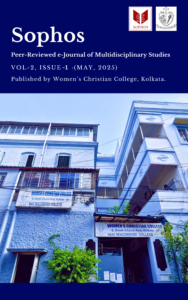
Vol-2, Issue-1, (May, 2025)
Peer-Reviewed e-Journal of Multidisciplinary Studies
Published by Women’s Christian College, Kolkata.
SOPHOS | Volume – 2, Issue – 1 (May, 2025)
Dr Ajanta Paul
Editor – in – Chief – Sophos Journal
Sophos is an annual, academic, peer-reviewed and open access electronic journal, hosted at its own domain, and published by Women’s Christian College, generally in June on interdisciplinary topics with a thematic focus in every issue.
The first issue of the online publication Sophos (Vol 1 No 1) of Women’s Christian College is not only a historic first of its kind for the institution but the source of what I hope will be a long tradition of intellectual enquiry and academic research undertaken under the aegis of the same.
The inaugural issue concerns the Covid 19 pandemic and its repercussions in India, especially in the socio-economic and higher educational sectors. From its effect on Indian agriculture, women’s education, in particular, and higher education in general, the media environment and changing cultural sensibilities, marginalized demographies such as the transgender community to the “shadow pandemic” – the research papers have addressed a variety of topics through engaging and thought-provoking enquiries, and succeeded in generating a lively discourse on the contemporary understanding of pandemic in its recent manifestations.
It is to be hoped that these reflections will contribute significantly to the growing corpus of work on the first pandemic of the present millennium, refracting the rays of insight which will surely enrich the cumulative vision that ensues as a result of such cross-cutting studies.
If we regard the activity of research after Charles Franklin Kettering to be a condition of “not knowing but (being) willing to find out,” in the best traditions of investigative and empirical exploration then not knowing the truth will, be truer than magisterial suppositions, and may, in fact, be an incentive to search for the same.
The motto of the present journal may, therefore, be to move from antithesis through hypotheses to synthesis – that superior organization of truth accessed through methodologies specific to the disciplines chosen.
May Sophos go from strength to strength in the coming years, and shed its light of wisdom on the world around it, illuminating the dark, and modulating the bright to a perfect chiaroscuro that yields the best balance in knowledge, and makes life worth living.
Dr Ajanta Paul
Editor – in – Chief – Sophos Journal
Principal – Women’s Christian College
Revisiting the Dynastic History of Nalas through the Lenses of Epigraphic and Numismatic Data
Rituparna Chattopadhyay
Sophos Journal | Vol-2, Issue-1 | May, 2025 | Page no- 1-11
Abstract
The Nalas were a minor dynasty who ruled in the ancient south Kośala (comprising of modern Bastar region of Chhattisgarh and some parts of Sambalpur region of Odisha) region during 4th to 8th century. The history of this dynasty is very much little known as there is dearth of properhistorical sources. Nalas were probably a forest tribe who ruled mainly forest tracts of the Bastar region. Later they emerged as a monarchical power and played an important role in the process of state formation of the region. The present article will look deep into the dynastic history of the Nalas on the basis of available epigraphic and numismatic data. The paper will also attempt to evaluate the relation of the Nalas with other contemporary power such as the Vākaṭakas or the Cālukyas.
Keywords: Nalas, South Kośala, Niṣadhadeśa, Vākaṭakas, Cālukyas.
Sophos © 2024 by Women’s Christian College is licensed under Creative Commons Attribution-NonCommercial 4.0 International
Governance on the Move: Caravans and State Control in Kauṭilīya Arthaśāstra
Soumya Ghosh
Sophos Journal | Vol-2, Issue-1 | May, 2025 | Page no- 12-20
Abstract
The Kauṭilīya Artha śāstra identifies vaṇikpatha (trade routes) as one of the ayaśarīra— legitimate source of state revenue — highlighting the economic significance of trade in early historic India. This paper explores how the text envisions a model state exercising control over trade routes, city-based markets, and itinerant traders to regulate exchange mechanisms and maximize fiscal returns. As early urban centers, often situated along long-distance trade routes, emerged as pivotal nodes of intra- and inter-regional commercial networks, markets within these cities became principal sites of commodity exchange. Central to this process were the sārtha-s (caravans) and sārthavāha-s (caravan leaders), who transported exotic regions and state boundaries. This study investigates the mechanisms suggested in the Artha śāstra for overseeing the movement and activities of caravan merchants and for managing wholesale markets where foreign and regional goods were integrated into local economies. It further examines the state’s role in facilitating monitoring, and taxing these transactions without directly engaging in the transfer of goods. Through a close reading of the Artha śāstra, the paper aims to reconstruct the state’s approach to market regulation, trade surveillance, and revenue generation, shedding light on broader patterns of governance and economic control in early historic India.
Keywords:State, Revenue, Caravan Trader, Resource Mobilization, Market.
Sophos © 2024 by Women’s Christian College is licensed under Creative Commons Attribution-NonCommercial 4.0 International
Quit India Movement in Manbhum: The Role of Satyagrahis in Selected Police Stations
Nondini Ray
Sophos Journal | Vol-2, Issue-1 | May, 2025 | Page no- 21-26
Abstract
The young blood to old women, every single person from all over India joined the Quit India Movement in 1942. Along with the Santals, Sabors, Kherias, Bhumijs, all the tribals, the residents of all classes of villages and cities, shoulder to shoulder, sacrificed themselves in front of the British bullets. Such a big awakening of the people had never happened before.This was the call of every human being to free the motherland from the shackles of oppression. All Congress institutions, meetings and committees were declared illegal by the British government. On August 10, all the leaders were arrested. The ‘Shilpashram’ was surrounded by the police. Since there was an arrest warrant against the Congress leaders, the residents of the ‘Shilpashram’ were asked to leave the ashram. But they did not agree. As a result, everyone was arrested. Atul Chandra Ghosh was arrested on his way back from attending the Congress session in Mumbai. Organizations like ‘Mukti’ press, Shilpashram, NibaranpalliShilpo-Sangha, Congress office and ashram were confiscated.This order was in force till 1945. Despite widespread arrests, the movement did not subside. Picketing, processions, strikes in educational institutions, occupation of police stations at various places, destruction of government property and so on did not stop. When one group was arrested, another group came forward. According to the official report sent from Bihar to the Government of India in 1942, there were 442 people arrested in Manbhum and 91 went to jail in this movement. The aim of this article is to explain the role played by the erstwhile Congress leadership and workers of different parts of district Manbhum as Satyagrahi in liberating the motherland.
Keywords: Gandhi,Movement,Manbhum, Congress
Sophos © 2024 by Women’s Christian College is licensed under Creative Commons Attribution-NonCommercial 4.0 International
The Forgotten History of an Explorer; Sarat Chandra Das (1849-1917)
Arnab Bera
Sophos Journal | Vol-2, Issue-1 | May, 2025 | Page no- 27-31
Abstract
In the 19th century, due to the influence of renaissance in Calcutta and Bengal, there was an unprecedented success in Bengali scientific practices in India in accordance with the agitation that was created throughout India. From the renaissance in Bengal, through the efforts of Raja Rammohun Roy, western knowledge and science education first spread in India, especially Philosophy, mathematics, geometry, astronomy, literature and history. Many such people have to be mentioned in the field of map making, has contributed in many ways to map making without actually being a cartographer.
Keywords: Map making, Tibet, Bengal, Science, Knowledge
Sophos © 2024 by Women’s Christian College is licensed under Creative Commons Attribution-NonCommercial 4.0 International
Sreemanti Laha
Priyanka Roy
Sophos Journal | Vol-2, Issue-1 | May, 2025 | Page no- 32-45
Abstract
This paper presents an integrated ethno-sociological and psychosocial analysis of the clay idol artisan community, settled in localities such as Kumartuli and Kalighat Patua Para in Kolkata, West Bengal. It examines two central themes through Psychological, Social and Philosophical lenses. First, it analyses into the socio-economic, ethical and psychological dimensions related with the practice of reuse of the wooden frameworks (used to make idols called Kathamo) observed in this community. Second, it investigates the experiences and the position of the female artisans in the community and how they navigate through a male dominated tradition. Using ethnographic fieldworks, semi-structured interviews, psychological and philosophical theoretical frameworks, this paper explores into themes of evolution of tradition, ethical negotiation, sustainability, socio-economic reorganisation, gender struggle and identifies areas for possible future researches.
Keywords: Kumartuli, Social Psychology, Sustainability, Women Artisans, Cultural Anthropology, Ethnography
Sophos © 2024 by Women’s Christian College is licensed under Creative Commons Attribution-NonCommercial 4.0 International
The Discernible Breakthrough In Bengali Cinema After Independence In 1947: An Analysis In Retrospect
Saptarshi Chakraborty
Sophos Journal | Vol-2, Issue-1 | May, 2025 | Page no- 46-54
Abstract
Keywords:
Sophos © 2024 by Women’s Christian College is licensed under Creative Commons Attribution-NonCommercial 4.0 International
Kusumika Dasgupta
Sophos Journal | Vol-2, Issue-1 | May, 2025 | Page no- 55-63
Abstract
Yashica Dutt is a Dalit Indian writer. Coming Out as Dalit is her memoir, published in 2019. Among other accolades, the book has also received the Sahitya Akademi Award, a prestigious award in India. This thesis critiques Dutt’s memoir from an intersectional Dalit feminist standpoint. It aligns with the ontological questions relating to the definition of Dalit/ Subaltern and whether or not the subalterns speak, addressing the conceptual monolith that is veritably at the bottom of the issue of an authentic Dalit/subaltern voice in the aggregated scholarly discourse of South Asia and constructing two arguments. One, Dutt, by instituting herself as a voicing subject, dispenses with performing within the influential narrative of subaltern unspeakability, and two, she, in the process of narrating her story, destructures the stereotypes essentializing Subalternity or Dalit womanhood. While Yashica Dutt is not the first memoirist to do this, she is indeed one of the most recent of the lot and does this influentially.
Keywords: Yashica Dutt, Memoir,Unspeakability, Subalternity, Dalit womanhood.
Sophos © 2024 by Women’s Christian College is licensed under Creative Commons Attribution-NonCommercial 4.0 International
Religion and Tradition: Re-constructing the Identity of Women in Twentieth Century Rajputana
Soma Ghosh
Sophos Journal | Vol-2, Issue-1 | May, 2025 | Page no- 64-74
Abstract
The primary objective of this paper is to establish the connection between tradition and religion and the role it played in the formation of the identity of women in twentieth century Rajputana. I will explore how the identity of women was defined among the Rajputs in that era and how religious symbols played a role in the formation of the identity of Rajput women. I have divided the essay into three parts, the first part focus on the sati system in Rajputana exploring the various stories about sati and how they played a role for the formation of gender identity and the reaction among the Rajput women about sati. The second part discusses about jauhar, the most glorified custom among the Rajputs and how the customwhich was practiced in medieval times still plays a role in constructing a unique identity for Rajput women.The third part considers the historical characters who were romanticized in twentieth century and their role in the formation of identity of women in twentieth century Rajputana. Interviews, extensive field surveys, existing literature on the subject and archival documents have been used here in support of thearguments. Theconcluding observations show howin the name of religion and tradition violence against women was glorified as a pious action and connected with the chastity and purity of a woman and was often used as a tool for upwardly social mobility of the caste.
Keywords: Rajput, Sati, Jauhar, Religion, Women
Sophos © 2024 by Women’s Christian College is licensed under Creative Commons Attribution-NonCommercial 4.0 International
India’s Concern About China’s Rising Role
Piyali Basu
Sophos Journal | Vol-2, Issue-1 | May, 2025 | Page no- 75-82
Abstract
This research article examines the context of China’s expanding global influence, characterized by its rising economic power, military modernization, and broader diplomatic engagements. In response, India’s efforts to bolster her military presence along the border, enhance partnerships with nations such as the United States, Japan, and Australia, underscores her strategy to counter China’s expanding military capabilities.
Keywords:Indian Ocean Region; China-Pakistan Economic Corridor; Belt and Road Initiative; Pakistan-Occupied Kashmir; Taliban.
Sophos © 2024 by Women’s Christian College is licensed under Creative Commons Attribution-NonCommercial 4.0 International
Somdatta Banerjee
Sophos Journal | Vol-2, Issue-1 | May, 2025 | Page no- 83-91
Abstract
Northeast India and Southeast Asia have a rich history of cultural, ethnic, and linguistic connections that span centuries. Their geographical closeness has encouraged migration, trade, and cultural exchanges, resulting in many shared traits among the populations of these regions. The ethnic diversity in Northeast India and Southeast Asia shows notable parallels. Numerous indigenous groups in Northeast India, including the Nagas, Mizos, Kukis, Bodos, and Ahoms, have ancestral ties to ethnic communities in Myanmar, Thailand, Laos, and other Southeast Asian countries. Anthropological studies suggest that many of these groups can trace their roots back to migration waves from the Sino-Tibetan and Austroasiatic areas of China and Southeast Asia. Linguistically, the Tibeto-Burman and Austroasiatic families are prevalent in both Northeast India and Southeast Asia. Languages like Bodo, Meitei (Manipuri), and various Naga dialects exhibit structural and lexical similarities with Burmese, Karen, and other Tibeto-Burman languages found in Myanmar, Thailand, and Laos.
This paper will discuss how, by strengthening connectivity and fostering people-to-people interactions, India can leverage these historical ties to create a more integrated and prosperous regional network, and how several challenges hinder deeper integration. Amidst this backdrop, the paper will explore the ethnic and linguistic similarities between Northeast India and Southeast Asia, highlighting how these connections form a solid basis for India’s Act East Policy.
Keywords:Northeast India, Southeast Asia, culture, ethnic, linguistic, connections, India’s Act East Policy, regional framework, soft power.
Sophos © 2024 by Women’s Christian College is licensed under Creative Commons Attribution-NonCommercial 4.0 International
The dichotomy between upholding Principles and Foreign Policy: A Study of Indo-Myanmar Relations
Devarati Mandal
Sophos Journal | Vol-2, Issue-1 | May, 2025 | Page no- 92-106
Abstract
The tapestry of international relations is often intertwined with principle and pragmatism, where states are compelled to steer through the intricacies of values, interest sand strategic imperatives. The central paradox that emerges here is -while India, a steadfast proponent of democratic principles whose foreign policy is firmly rooted on the principle of upholding and strengthening democratic values and aspirations, compelled by security imperatives, has concurrently engaged with Myanmar- a nation governed by an authoritarian regime that has repeatedly nibbed the democratic struggles. Initially, India, cognizant of the imperative of upholding democratic ideals, extended support to the democratic struggle and provided sanctuaries along with financial aid to political activists from Myanmar. But eventually, in the post-cold-war scenario being mindful of it senduring strategic imperativesin the region, India, prudently cultivated relations with the military administrations of Myanmar as well. Discernibly, the overarching supremacy of the army has its bearings over the foreign policy outcome sand heavily influenced the trajectories of Indo-Myanmar relations. Therefore, India’s relationship with Myanmar has been characterized by its dual nature- over time, oscillating between periods of trust and suspicion.
This transformative process is not only indicative of the potential for pragmatic engagement with regimes of varying political orientations but also emphasises the degree of instrumental role that security imperatives can play in shaping the contours of bilateral relations. Thus, the apparent incongruity in the ever-evolving dynamics between democratic ideals and engagement with authoritarian regimes, which is evident in Myanmar, demands further exploration.
Keywords:Myanmar, Democratic Transition, Realism, Security imperatives, Military Junta, counter-insurgency.
Sophos © 2024 by Women’s Christian College is licensed under Creative Commons Attribution-NonCommercial 4.0 International
Aritra Majumdar
Sophos Journal | Vol-2, Issue-1 | May, 2025 | Page no- 107-116
Abstract
The Sino-Indian conflict of 1962was part of a decade in which India had to fight three major wars against her neighbours viz. China and Pakistan. Such exigencies demanded a reorientation of the priorities of the developmental state towards armed conflict. This required a reappraisal of the role of various sections of state and society in the context of the External Emergency. The press, long critical of the inefficient handling of publicity, sought vital changes to how the government sought to sway international opinion in its favour and build public morale at home.
This article seeks to revisit thepress reportage and debates during and after the war, on the importance and modalities of wartime publicity. Drawing upon press coverage, archival sources and journalists’ memoirs, it will be argued that the difficulties faced by both the press and the government in disseminating information about the conflict resulted in slow but lasting changes to the publicity apparatus of the government and the role of the press in the defence effort.The lessons learnt during the conflict would enable better exchange of information between the press and the government through institutional mechanisms during later conflagrations of 1965 and 1971.
Keywords:War Reportage, Sino-Indian Conflict, Indian state, press freedom, War Publicity.
Sophos © 2024 by Women’s Christian College is licensed under Creative Commons Attribution-NonCommercial 4.0 International
Role of Media in Democratic Politics in India
Sanchita Chakrabarti
Sophos Journal | Vol-2, Issue-1 | May, 2025 | Page no- 117-122
Abstract
The role of media in democratic governance constitutes an important part in understanding the functioning of democracy across the globe. On one hand the traditional form i.e.print mediaand broadcastingmedia have been aone sidedform of communication with limited participation from the audience while on the other hand social media is a two way means of communication between the political leaders and the electorate. Post-independence the ‘public sphere’ in India was dominated by print media, followed by electronic media in later phases and was state controlled till 1990s. With liberalization, private players brought competition within the forms of media and also between electronic and print media leading to commodification of news. This had huge implications for democratic politics as reflected during elections. The advent of social media in the later period developed a new democratic discourse.This paper traces the journey of media in India after independence, the major transformation it has undergone in the post reform period along with the advent of social media and its implication for democratic politics in India.
Keywords: Media,democracy,electorate,elections, politicalcampaign
Sophos © 2024 by Women’s Christian College is licensed under Creative Commons Attribution-NonCommercial 4.0 International
Impact of Pandemic on different levels of Education in India
Tapash Das
Tarini Halder
Sophos Journal | Vol-2, Issue-1 | May, 2025 | Page no- 123-134
Abstract
In India, a nation with wide-ranging socioeconomic and regional inequalities, the COVID-19 pandemic had a tremendous impact on educational systems around the world. The article examines the pandemic’s complex effects on education at the primary, secondary, higher education, and open and distance learning levels. This article is based on reputed secondary sources. All levels of education in India were severely disrupted by the COVID-19 pandemic, which exposed structural vulnerabilities and exacerbated pre-existing inequalities. Children in marginalized areas who had little access to digital resources were disproportionately affected by school closures, which hampered social interaction, cognitive development, and basic learning at the primary level. Due to the difficulties of online learning and disruptions to board exams, learning gaps, dropout rates, and student anxiety have all increased significantly in secondary education. The shift to online platforms in higher education has exposed disparities in access to technology and internet connectivity, especially in rural areas. There have been major delays in academic schedules, examinations, internships, and placements, which have negatively impacted students’ career paths. Despite being better equipped to withstand disruptions, open and distance education has faced challenges with infrastructure, inclusion, and student engagement. But it has also shown flexibility and resilience, becoming an important option in times of crisis.
Keywords: Impact, Pandemic, Primary Education, School Education, Higher Education, Open and Distance Education.
Sophos © 2024 by Women’s Christian College is licensed under Creative Commons Attribution-NonCommercial 4.0 International
COVID-19 Lockdown and Internal Migrants in India: Issues, Vulnerability and Mitigation
Lakshman Chandra Pal
Sophos Journal | Vol-2, Issue-1 | May, 2025 | Page no- 135-145
Abstract
India was one of the worst COVID-19 disease-affected countries in the world. This situation impelled the government to implement a nationwide lockdown for a period of sixty-six days. All the sectors of the economy, including manufacturing, construction, trade, and commerce, were closed, jeopardizing the livelihood of the nation during that time. Millions of informal sector workers lost their jobs. Migrant workers, especially the daily-wage labourers, dropped into a vulnerable situation. Many of them started walking or bicycling towards their hometown or villages. Hundreds of them died of hunger or from meeting with an accident on their journey. To alleviate the situation, the Government of India took a number of important measures, like arranging trains, free rationing, free food and shelter, free treatment, job openings, direct cash transfer for their livelihood, and so on. The present paper is an attempt to analyze the impact of the COVID-19 lockdown on the issues and vulnerability of India’s internal migrants faced during their return journey, the steps taken by the government, and recommendations for the way forward.
Keywords:Pandemic situation; COVID-19 lockdown; Migrant workers; Internal migration; Vulnerability;
Sophos © 2024 by Women’s Christian College is licensed under Creative Commons Attribution-NonCommercial 4.0 International
Purnima Mallick
Sophos Journal | Vol-2, Issue-1 | May, 2025 | Page no- 146-158
Abstract
Sustainable development through nature-based tourism is become aconcerning issue today, which helps to conserve resource and preserves local cultural traditions. Nature-based tourism increases financial mobility in a positive way overits multifaceted impact and in real sense, it helps to conserve the nature. There is a scope to increase diversified income opportunities without hampering the local indigenous culture that reduces the negative impact on the environment.
The natural landscape of Purulia district of West Bengal is extensively popular for its rich indigenous cultural heritage woven with a wide range of natural produces. Fiery red Palash (scientific name-ButiaMonosperma) flower blooming in spring season in Purulia district is one of the main attractions of the nature lovers. Acquitted, hospitable and welcoming residents of the district possess the trustworthy appeal and enthusiasm to greet visitors during Palash blooming season. The study analyses the likelihoods of embryonic nature-based tourism activity in the Palash blooming areas of Purulia district. This paper also tries to explore the opportunities of economic development of the local tribal people by means of alternative livelihood through the nature-based tourism.
After quantifying various attributes collected in the form of primary information through structured questionnaire, descriptive statistics has been calculated to know the status of different parameters considered for the study. Cartographic techniques have been used for diagrammatic representation of the various attributes. The study finds that the nature-based tourism may help the local communities of the area to fast-track theirliving standard. Protecting and managing the forest resources and to ensure benefits arising from the use of biodiversity should be the prime focus of the promotion of tourism activity by natural way in Palash flower flourishing parts of Purulia district.
Keywords: nature-based tourism, sustainable tourism, tribal people, economic development, alternative livelihood.
Sophos © 2024 by Women’s Christian College is licensed under Creative Commons Attribution-NonCommercial 4.0 International
Habin Thomas
Sophos Journal | Vol-2, Issue-1 | May, 2025 | Page no- 159-172
Sophos © 2024 by Women’s Christian College is licensed under Creative Commons Attribution-NonCommercial 4.0 International
Sophos © 2024 by Women’s Christian College is licensed under Creative Commons Attribution-NonCommercial 4.0 International
DOWNLOAD THE COMPLETE ISSUE.
DOWNLOAD THE COVER.