

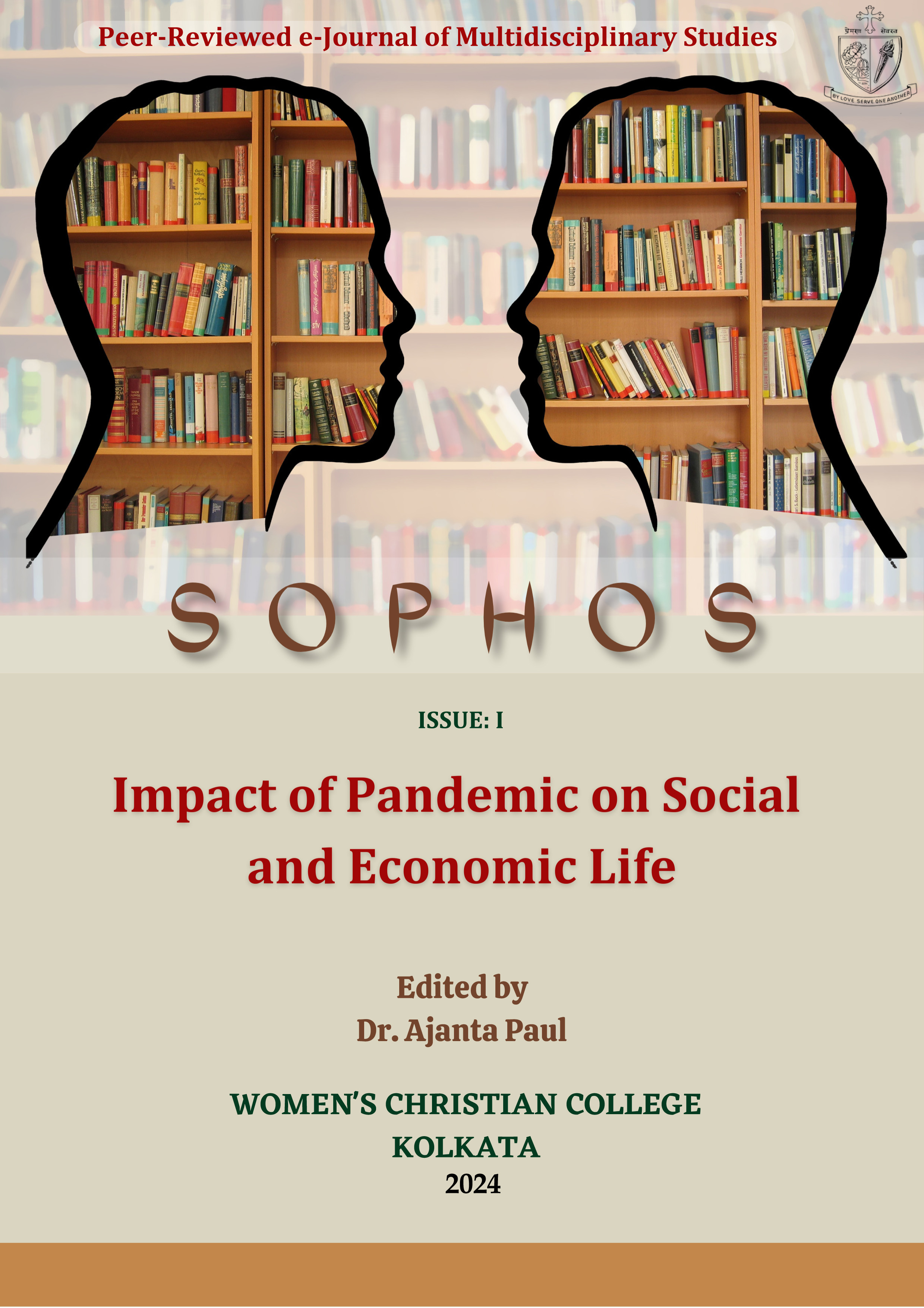
Vol-1, Issue-1, (May, 2024)
Peer-Reviewed e-Journal of Multidisciplinary Studies
Published by Women’s Christian College, Kolkata.
SOPHOS | Volume – 1, Issue – 1 (May, 2024)
Editorial
Dr Ajanta Paul
Editor – in – Chief – Sophos Journal
Principal – Women’s Christian College
Address – 6, Greek Church Row Ext, Kalighat, Kolkata-700026
Sophos is an annual, academic, peer-reviewed and open access electronic journal, hosted at its own domain, and published by Women’s Christian College, generally in June on interdisciplinary topics with a thematic focus in every issue.
The first issue of the online publication Sophos (Vol 1 No 1) of Women’s Christian College is not only a historic first of its kind for the institution but the source of what I hope will be a long tradition of intellectual enquiry and academic research undertaken under the aegis of the same.
The inaugural issue concerns the Covid 19 pandemic and its repercussions in India, especially in the socio-economic and higher educational sectors. From its effect on Indian agriculture, women’s education, in particular, and higher education in general, the media environment and changing cultural sensibilities, marginalized demographies such as the transgender community to the “shadow pandemic” – the research papers have addressed a variety of topics through engaging and thought-provoking enquiries, and succeeded in generating a lively discourse on the contemporary understanding of pandemic in its recent manifestations.
It is to be hoped that these reflections will contribute significantly to the growing corpus of work on the first pandemic of the present millennium, refracting the rays of insight which will surely enrich the cumulative vision that ensues as a result of such cross-cutting studies.
If we regard the activity of research after Charles Franklin Kettering to be a condition of “not knowing but (being) willing to find out,” in the best traditions of investigative and empirical exploration then not knowing the truth will, be truer than magisterial suppositions, and may, in fact, be an incentive to search for the same.
The motto of the present journal may, therefore, be to move from antithesis through hypotheses to synthesis – that superior organization of truth accessed through methodologies specific to the disciplines chosen.
May Sophos go from strength to strength in the coming years, and shed its light of wisdom on the world around it, illuminating the dark, and modulating the bright to a perfect chiaroscuro that yields the best balance in knowledge, and makes life worth living.
Dr Ajanta Paul
Editor – in – Chief – Sophos Journal
Principal – Women’s Christian College
Unfolding The Impact of Pandemic on Socio-Economic Life of Kolkata Street Food Vendors
Adrija Sinha
Anindya Basu
Sophos Journal | Vol-1, Issue-1 | May, 2024 | Page no- 1-15
Abstract
The global repercussions of the COVID-19 pandemic have caused substantial adverse effects worldwide, particularly affecting street vendors in developing nations, including India. This paper specifically investigates the impact of the pandemic on street food vendors in Kolkata since they lacked the skills and resources to overcome shocks. The goal is to understand the demographic characteristics of these vendors, examine the socio-economic challenges faced during and post lockdown, and analyse their coping strategies and mitigation measures in response to these adverse effects.
Keywords: Street Food, Kolkata, COVID-19 Pandemic, Hygiene, Digital Integration
Sophos © 2024 by Women’s Christian College is licensed under Creative Commons Attribution-NonCommercial 4.0 International
Arnab Majumdar
Sophos Journal | Vol-1, Issue-1 | May, 2024 | Page no- 16-23
Abstract
Like every other country, India has also been immensely affected by the Covid19 pandemic. Not only India’s economic growth process has been hampered but it has been pushed back by quite a few years. In this background, it may be a worthwhile proposition to assess the impact of Covid and its subsequent restrictions on India’s agricultural sector. The study attempts to assess the pandemic’s impact on India’s agricultural sector focussing on the different aspects of the sector and also takes a look at the government’s response to the situation and what is required from the agricultural sector in future.
Keywords: Lockdown, Farm-gate prices, Agri-inputs, NABARD, Fiscal, Legislative
Sophos © 2024 by Women’s Christian College is licensed under Creative Commons Attribution-NonCommercial 4.0 International
An Interrogation of the Lingering Impact of the Pandemic on Women’s Education in India
Jayita Mukhopadhyay
Sophos Journal | Vol-1, Issue-1 | May, 2024 | Page no- 24-31
Abstract
Socio-political impact of the Covid 19 pandemic has been far reaching and in India, besides other aspects, it has very adversely affected education, particularly girls’ and women’s education. Even after the pandemic, education of this segment of population continues to bear the burnt of the catastrophe. This paper explores the nature of this malady at both pan India level and at the level of our own state West Bengal so as to make some humble suggestions about ways of overcoming this affection.
Key words: Impact of Covid 19, Gender Inequality, Girls’education, Women’s education, Child Marriage, Digital Education, Public Education System.
Sophos © 2024 by Women’s Christian College is licensed under Creative Commons Attribution-NonCommercial 4.0 International
Post-Pandemic Impact on Higher Education
Nabanita Mitra
Sophos Journal | Vol-1, Issue-1 | May, 2024 | Page no- 32-40
Abstract
The Covid 19 Pandemic has perhaps been a mixed bag for the higher education sector, both in India and elsewhere. While some have alleged that the pandemic had ushered in unforeseen changes in the pedagogical system the world over, almost leading to an acute academic slump of sorts, there have been others who have hailed the new normal as the harbinger of academic flexibility and technological sustainability. This article attempts to show how the higher education sector, especially in India, has had to negotiate the adverse effects of the pandemic though an unprecedented academic resilience and genuine stakeholder-empathy.
Keywords: Covid 19 Pandemic, Online Learning, HEIs, Digital Platforms, Academic flexibility.
Sophos © 2024 by Women’s Christian College is licensed under Creative Commons Attribution-NonCommercial 4.0 International
Samarpita Ghosh Ray
Sophos Journal | Vol-1, Issue-1 | May, 2024 | Page no- 41-50
Abstract
The paper explores the resilient adaptations of the popular film industry in the post pandemic scenario. Incremental changes in the media industry and convergence of media with the advent of the global created challenges for the big screen which in the pandemic period led to its near decline. The new configurations in the media industry that has disembedded entertainment from collectivized solid spaces of cinema halls to individuated private intimate spaces through. access to mobile and internet enabled entertainment are to be read as wider socio-political and economic ramifications within a post-colonial and post-global society.
Keywords- Pandemic, Giant Silver Screen, Media Convergence, Globalization, OTT Revolution, Entertainment, Disembededness
Sophos © 2024 by Women’s Christian College is licensed under Creative Commons Attribution-NonCommercial 4.0 International
Analyzing The Shadow Pandemic in India Through Connell’s Hegemonic Masculinity
Somdatta Banerjee
Sophos Journal | Vol-1, Issue-1 | May, 2024 | Page no- 51-58
Abstract
The SARS-CoV-2 virus caused a major global crisis, affecting communities worldwide with the COVID-19 pandemic. To stop the pandemic the government was forced to declare lockdown. While the intention behind lockdown measures was to keep citizens safe, they unintentionally made existing gender inequalities even worse, especially for women. This article delves into the issue of domestic violence in India during the COVID-19 crisis, taking a close look at it through Connell’s concept of hegemonic masculinity. It would explore how lockdowns intensified domestic violence, showing how COVID-19 and gender-based violence collided. It would also shed light on the challenges faced by women and the societal structures that perpetuate violence and emphasize the urgent need for gender-sensitive responses to crises.
Keywords: COVID-19 pandemic, shadow pandemic, domestic violence, gender inequality, hegemonic masculinity, lockdown measures
Sophos © 2024 by Women’s Christian College is licensed under Creative Commons Attribution-NonCommercial 4.0 International
Margins of an Epidemic: Migrants and Covid 19
Samata Biswas
Sophos Journal | Vol-1, Issue-1 | May, 2024 | Page no- 59-65
Abstract
In the present paper I examine the historical and contemporary intersection of pandemics with the persecution of different kinds of migrant populations, with a particular focus on the Covid-19 pandemic. The first part of this paper explores historical instances of the persecution of migrants during past epidemics, ranging from ancient Greece to the colonial and 19th-century global pandemics. Epidemics often led to the vilification of migrants, who were seen as vectors of disease. The second part focuses on the Covid-19 pandemic, analyzing global patterns of exclusion, surveillance, and dehumanization faced by migrants, refugees, and asylum seekers, including cases of forced confinement, pushback, and invasive medical practices. With examples from India, the U.S., and Europe, I highlight the enduring vulnerability of marginalized populations in the face of global crises. The pandemic exacerbated pre-existing inequalities, revealing the deeply entrenched suspicion and discrimination that migrants face. Migrant women experienced heightened risks of sexual violence, trafficking, and exploitation. Despite spectacular distress, migration continued nevertheless, exacerbated by new conflicts, economic slowdown and climate crisis. By connecting past and present, I call for a nuanced understanding of the relationship between migration, public health crises, and social exclusion.
Keywords: Covid 19, pandemic, migrants, refugees, asylum seekers, persecution
Sophos © 2024 by Women’s Christian College is licensed under Creative Commons Attribution-NonCommercial 4.0 International
A Long Hyphen: Covid Crisis, Digital Learning, and Creativity
Dr Tanmoy Bhattacharjee
Sophos Journal | Vol-1, Issue-1 | May, 2024 | Page no- 66-70
Abstract
The outbreak of covid has taken the world by awe, no doubt, but, at the same time, it has severely impacted the usual ways of teaching-learning. It may be said that covid, despite being a gargantuan crisis, is an important cognitive-affective phase in human development in general and for the student-community in particular. Learning, according to the recent pedagogical findings, is of two broad categories— (a) the visually oriented learning and (b) the haptically determined one. In the face of a common predicament like covid, the hierarchy between these two types has just fizzled away, yielding place to a digital deterritorialization and reterritorialization of experience. The discrimination, of course, doesn’t vaporize overnight but, at least, it is loudly acknowledged. This paper examines how the sudden yet an indispensable advent of multiple digital interfaces, indeed, conjures an atmosphere for the use and celebration of interdisciplinarity and how the coalescing of disciplines naturally translates into fabulous creative outputs, especially in the realm of teaching-learning.
Keywords: covid crisis, teaching-learning, digital terrains, interdisciplinarity
Sophos © 2024 by Women’s Christian College is licensed under Creative Commons Attribution-NonCommercial 4.0 International
Impact Of Covid-19 On Education of School Going Students
Priyanka Sikder
Dr. Sanju Das
Sophos Journal | Vol-1, Issue-1 | May, 2024 | Page no- 71-81
Abstract
The outbreak of COVID-19 pandemic has unpleasantly influenced the education of approximately 1.6 billion learners throughout the world. The long closure of the educational institutions and learning sectors have impacted the student community which in turn, brought far-reaching changes in all aspects of their lives. An incessant lockdown has compelled the human being to follow social distancing and strict restriction in movement policies. The conventional educational practices e.g., regular attendance of school, meeting with classmates, student-teacher interaction, regular evaluation process of offline learning have been disrupted within a short span of COVID-19 pandemic.
Keywords: COVID-19, Pandemic, School Education, Online Class
Sophos © 2024 by Women’s Christian College is licensed under Creative Commons Attribution-NonCommercial 4.0 International
Work from Home & Work for Home: Indian Working Women through the lens of Post Pandemic Period
Dr. Shreya Ganguly
Sophos Journal | Vol-1, Issue-1 | May, 2024 | Page no- 82-89
Abstract
The COVID-19 pandemic significantly reshaped the work-life balance for Indian working women, blurring the lines between professional and domestic roles. This paper explores the dual burden of “work from home” and “work for home” that woman experienced during and after the pandemic, with a focus on the post-pandemic period. The study examines how societal expectations and traditional gender roles intensified domestic responsibilities, while the shift to remote work increased professional workloads. Drawing on a gendered lens, it explores the intersectionality of gender, class, and socio-economic status, highlighting how women from different social strata faced varying challenges. Middle and upper-class women often navigated the pressures of balancing extended work hours with household duties, while lower-income women in informal sectors dealt with job insecurity and lack of resources. The paper also discusses the impact of these pressures on productivity, mental health, and career progression. Finally, it proposes policy recommendations aimed at fostering gender equality, including flexible work policies, accessible childcare, and better mental health support. The research calls for systemic change at both organizational and societal levels to ensure sustainable empowerment for working women in India, especially in a post-pandemic world.
Keywords: Work from Home, Work for Home, Gender Equality, Indian Working Women, Post-Pandemic, Domestic Responsibilities, Intersectionality.
Sophos © 2024 by Women’s Christian College is licensed under Creative Commons Attribution-NonCommercial 4.0 International
Manjari Jaruhar’s Madam Sir. The Story of Bihar’s First Woman IPS Officer
Tumpa Mukherjee
Sophos Journal | Vol-1, Issue-1 | May, 2024 | Page no- 90-91
Sophos © 2024 by Women’s Christian College is licensed under Creative Commons Attribution-NonCommercial 4.0 International
DOWNLOAD THE COVER.